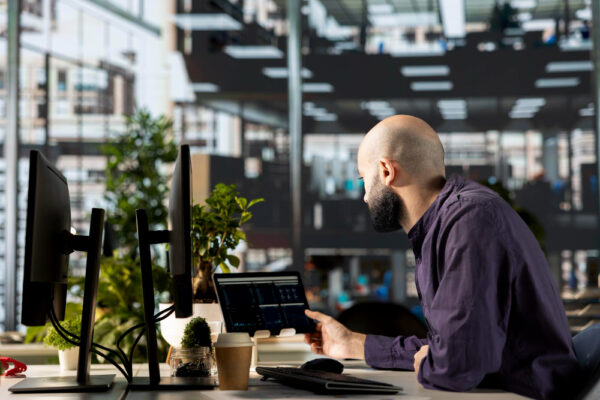



Companies that spent years shrinking their office space are now making a striking U-turn. Instead of cutting square metres, they are investing in high-quality, sustainable workspaces. This strategic shift reflects a fundamental change in how organisations view their office space: no longer as a cost item to be minimised, but as an investment in employee satisfaction, productivity and company culture.
From shrinking to quality: a historic turning point
The office market is at a historic turning point. For the first time in at least 25 years, more office space is being taken out of the market than added to it. This might sound like a crisis, but the opposite is true. What we’re seeing isn’t a defensive retreat, but a deliberate choice by companies to align their office space with their organisation’s actual needs.
This development is often described as finding the right size rather than simply shrinking. The distinction matters: where shrinking implies necessity, this is about finding the best balance between space, quality and usage. Companies are leaving outdated, oversized office buildings and deliberately choosing smaller but higher-quality spaces in more favourable locations.
Investment in European offices rose by thirty percent in 2025, after years of uncertainty. This recovery is most visible in modern, energy-efficient buildings in prime locations. As a result, the market is splitting into two: high-quality buildings that remain in demand, and outdated buildings that sit vacant for long periods.
Hybrid working calls for different offices
Hybrid working is not a temporary trend, but a lasting change in how we work. Forty-three percent of organisations now use a fixed hybrid model in which employees come into the office a set number of days per week. On average, people now work just 2.9 days a week in the office. This has major implications for how office space is designed and used.
As a result, traditional offices with a fixed desk for everyone are outdated. Instead, many organisations are choosing a layout where employees pick the workspace that suits their tasks for the day. There are quiet zones for focused work, open spaces for collaboration, and informal areas for spontaneous conversations. The modern office offers a suitable environment for every type of work.
Research shows that almost seventy percent of Dutch employees have no mandatory office days, or at most two. This has led to a redesign of offices. Where around seventy percent of space used to be allocated to individual workstations and thirty percent to collaboration, experts expect this ratio to shift by 2030 to forty percent individual workstations and sixty percent space for meeting and collaboration.
Sustainability and regulation as drivers
Requirements for office buildings are becoming increasingly strict. Since 2023, all office buildings in the Netherlands must have at least energy label C. That means primary fossil energy consumption may not exceed 225 kilowatt-hours per square metre per year. At the start of 2026, eighty-four percent of total office space meets this requirement, but action is still needed for the remaining sixteen percent.
In addition, the EU’s Corporate Sustainability Reporting Directive requires large companies to report on their sustainability performance from 2025 onwards. Office space plays an important role in this. Choosing a sustainable building is not just a practical decision, but also a clear signal to investors, clients and prospective employees.
As a result, companies are increasingly choosing buildings with a recognised sustainability certification, such as BREEAM. Such certification assesses not only energy consumption, but also health, material reuse and future-proofing. Organisations that choose renovation over new construction can save on costs while also reducing their environmental footprint by using less construction waste and fewer new materials.
The real cost of quality
A high-quality office costs more per square metre, but the total costs paint a more complete picture. The average rent for office space in the Netherlands is between 130 and 132 euros per square metre per year. On top of that come service charges of thirty to eighty-five euros per square metre, plus any costs for fit-out and facilities.
Amsterdam tops the list with prices of up to five hundred euros per square metre on the Zuidas. In less central locations within the same city, prices range between one hundred fifty and two hundred fifty euros. Rotterdam is somewhat cheaper, with prices between one hundred and two hundred seventy-five euros. In Utrecht and The Hague, rents average between one hundred sixty and one hundred eighty-five euros.
For a team of twenty employees under a hybrid work model, this works out to around thirty-two thousand euros a year in Rotterdam, or one hundred three euros per employee per month. That may sound like a lot, but weighed against the costs of staff turnover, sick leave and lost productivity from a poor work environment, investing in quality often turns out to be the more cost-effective option.
Why companies are choosing quality
The main reason behind this shift is talent retention. Research shows that employees who can decide for themselves when to come into the office do so voluntarily more often than when it’s mandatory. An attractive office with good facilities, a thoughtful layout and attention to wellbeing encourages people to collaborate, even without a fixed attendance requirement.
The link between workplace quality and employee satisfaction is clearly measurable. Companies that invest in ergonomic workstations, good acoustics, natural light and greenery see an average productivity increase of around ten percent. In addition, sick leave drops by around thirty-five percent and staff turnover falls by fifty-eight percent.
The tightness of the labour market also plays an important role. At a time when good staff are scarce, the work environment makes the difference. Job seekers look not only at salary and benefits, but also at where they’ll be working. A modern, sustainable office in a good location shows that an organisation invests in its people and keeps up with the times.
Choosing the right office solution
Today’s office market offers a range of solutions for different needs. A traditional leased office gives maximum control over layout and image, but requires larger upfront investments and longer lease terms. Flexible office concepts with furnished spaces and additional services offer more freedom of movement, but at a higher cost per square metre.
Shared workspaces are especially popular among freelancers and small teams who value contact with others. For larger organisations seeking flexibility, there are increasingly office concepts with different zones for different types of work.
The right choice depends on factors such as expected growth, financial resources, desired flexibility and specific space requirements. Smaller organisations with uncertain growth often opt for flexible solutions despite the higher price per square metre. Stable organisations with long-term plans are generally better off with a traditional lease.
Location remains crucial
Accessibility tops the list of important factors when choosing an office location. It’s not just about geographic position, but also good public transport connections, sufficient parking and how appealing the surrounding area is. Offices within walking distance of a central station remain popular because they limit employees’ commuting time.
Interestingly, location has become even more important since hybrid working became the norm. If employees come into the office only two or three days a week, both the quality of the office and its location need to make the trip worthwhile. Employees are more willing to accept a longer commute for a well-located, appealing office than for a mediocre workplace in an inconvenient location.
This explains why companies are willing to pay higher rents for better locations. Research shows that large organisations rent seven point five percent fewer square metres on average, yet pay twenty-seven percent more for prime locations. Location also conveys an organisation’s identity and ambitions to clients, partners and future employees.
Investing in the future
The shift from quantity to quality in office space is not a temporary development, but a lasting change. The shortage of high-quality, sustainable office space will continue to grow in the coming years, while outdated buildings become increasingly difficult to let. Organisations that choose quality now are strengthening their position for the future.
Financially, too, investments in sustainability are becoming increasingly attractive. LED lighting typically pays for itself within one to two years, and better insulation within five to seven years. But the biggest gains lie in the indirect effects: less staff turnover, lower sick leave and higher productivity. For organisations that depend on knowledge and expertise, these benefits can far outweigh the extra costs of a high-quality office.
The future of office space is about creating value for employees, not about keeping costs as low as possible. Organisations that understand this and act on it improve their chances of success in the battle for talent and in building a productive and inspiring work environment. The modern office isn’t a cost item, it’s a strategic investment in the organisation’s future.


 info@deskfinder.nl