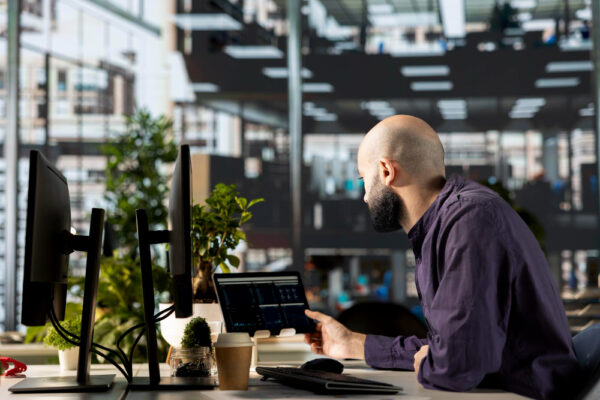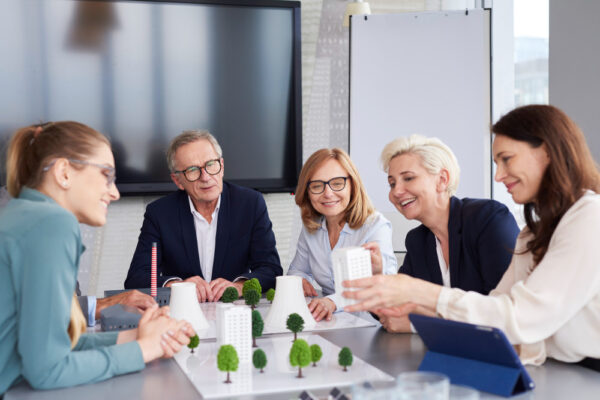



The modern office is changing radically. Where employees used to sit at the same desk for years, they now choose a workspace each day that fits the task at hand. This shift towards Activity Based Working (ABW) is no longer just a trend, but increasingly a necessity. With 63% of large Dutch companies allowing employees to work from home at least three days a week, organisations need to fundamentally rethink their office space.
In het kort (TLDR)
- Activity-based working means there is no fixed workstation; instead, employees choose their workspace based on the task at hand.
- Fewer square metres per employee, but a greater variety of space types.
- The transition requires investment in technology, furniture and a change in culture.
What exactly is Activity Based Working?
Activity Based Working is based on a simple principle: you choose your workspace based on what you are doing, not based on who you are. You make phone calls in a phone booth, brainstorm in an open collaboration area and use a quiet focus zone for deep work. The office changes from a collection of fixed desks into a dynamic environment with different work zones.
This approach has a direct impact on the amount of office space companies need. Traditional offices typically use around 16.5 m² per employee, while organisations using ABW may be able to reduce this to 14.3 m² by 2030. That represents a saving of roughly 8% to 15% in office space, which can be significant when rental prices at prime locations such as Amsterdam’s Zuidas reach €400 to €500 per m².
The new reality: the office as a meeting place
The office of 2025 is no longer simply the place where employees go to work individually. Increasingly, it is where people come together to collaborate. With an average office occupancy rate of just 59%, compared with 65% before the pandemic, it is clear that the role of office space has changed significantly. Focused work is increasingly done from home, while the office is becoming a place for collaboration, knowledge sharing and team building.
This shift requires different types of spaces. Companies are now investing in:
- Hybrid meeting rooms for video calls with colleagues working from home
- Focus zones with good acoustic facilities, covering around 20% to 25% of the space
- Collaboration zones for brainstorming and project work, covering around 15% to 20%
- Breakout areas and social meeting spaces
- Flexible workstations with modern technology
The challenges of flexible working
Not everything about ABW is straightforward. One of the biggest complaints is noise. Open-plan offices can reduce productivity during focused work by 15% to 20%. In addition, 64% of employees still prefer having a fixed workspace. This tension between flexibility and the desire for a personal desk remains a serious challenge.
Privacy is another important consideration. Confidential conversations in open spaces, sensitive documents left on shared desks and colleagues being able to see your screen are all genuine concerns. Successful ABW implementations address these issues by providing separate meeting rooms, phone booths and clear workplace guidelines.
Implementation: more than moving furniture
Switching to Activity Based Working requires more than simply changing the office layout. It is a cultural change that starts with trust. Managers need to move away from the idea that physical presence equals productivity. Employees, meanwhile, need to get used to the idea that they no longer have a dedicated desk.
A successful implementation usually follows these steps:
- Baseline assessment (2 to 4 weeks): Measure current occupancy and analyse which activities take place in which areas.
- Develop a vision (2 to 4 weeks): Define the ideal working environment together with the team and establish a budget.
- Design (4 to 6 weeks): Determine the different zones and develop the office layout.
- Implementation (4 to 12 weeks): Carry out the refurbishment in phases, preferably during quieter or holiday periods.
- Training (1 to 2 weeks): Help employees adapt to the new way of working through tours, guidance and clear rules.
- Monitoring (ongoing): Track occupancy, collect feedback and make adjustments where necessary.
The financial reality
ABW can lead to cost savings, but the reality is more nuanced. Companies may save on square metres, but investment in high-quality furniture, acoustic solutions and technology can quickly reach €30,000 to €100,000. Shorter lease agreements, which are increasingly popular because of their flexibility, can also come with a premium of 10% to 20%.
For small teams of 5 to 10 people, ABW is often not financially worthwhile. The complexity and costs may outweigh the limited space savings. The benefits usually become more noticeable in organisations with around 40 employees or more, especially when hybrid working is already the norm.
Sustainability as the new standard
One notable development is that many companies are choosing more expensive offices despite reducing the amount of space they use. The reason is that sustainability and location are becoming increasingly important. With 82% of Dutch offices now meeting energy label C or higher, and companies being encouraged through reporting regulations to operate more sustainably, energy-efficient office buildings are becoming the new standard. These properties can cost 20% to 30% more, but they may also offer lower energy costs and a stronger image for both clients and potential employees.
Employees are also placing higher demands on the workplace. Research shows that 92% would be more willing to come into the office if the facilities were better. Fresh air, natural light, good coffee and spaces to relax can make the difference between an empty office and a lively, attractive workplace.
The future of work
Activity Based Working is not a final destination, but an ongoing process. With demand for office space expected to fall by 8.7% by 2030, companies need to become more flexible. The strongest approach combines space savings with investment in quality. A smaller but better office in a prime location, with excellent facilities, can attract talent and encourage collaboration.
The lesson for companies is clear: ABW can work, but only with the right approach. It requires committed management, active employee participation and continuous optimisation. For organisations willing to make that investment, a more efficient, dynamic and attractive working environment is within reach. The office of the future is already here; we simply need to learn how to use it effectively.


 info@deskfinder.nl